Difference between revisions of "Erosion"
ChristineLN (talk | contribs) |
ChristineLN (talk | contribs) |
||
| (43 intermediate revisions by the same user not shown) | |||
| Line 6: | Line 6: | ||
==Overview== | ==Overview== | ||
| + | [[File:Erosiondiagram.png|500px|thumb|right|Runoff moves dislodged soil from upland areas to lower elevations (TRCA, 2020).<ref name = "TRCA2020">TRCA. 2020. Ravine and Bluff Brochure. https://trcaca.s3.ca-central-1.amazonaws.com/app/uploads/2020/04/27105442/Ravine-and-Bluff-Brochure.pdf</ref>]] | ||
| + | |||
Erosion is the movement of earthen materials from one area to another due to forces such as wind, water, and ice. This process occurs slowly under natural conditions. However, erosion is often accelerated by anthropogenic activities, such as [[Erosion and Sediment Control|construction]], agriculture, and deforestation (AAFC, 2025)<ref>Agriculture and Agri-Food Canada. 2025. Soil erosion. https://agriculture.canada.ca/en/environment/resource-management/indicators/soil-erosion.</ref>. This accelerated rate of erosion can compromise the effectiveness of LID systems and impact watershed health. | Erosion is the movement of earthen materials from one area to another due to forces such as wind, water, and ice. This process occurs slowly under natural conditions. However, erosion is often accelerated by anthropogenic activities, such as [[Erosion and Sediment Control|construction]], agriculture, and deforestation (AAFC, 2025)<ref>Agriculture and Agri-Food Canada. 2025. Soil erosion. https://agriculture.canada.ca/en/environment/resource-management/indicators/soil-erosion.</ref>. This accelerated rate of erosion can compromise the effectiveness of LID systems and impact watershed health. | ||
| − | Managing the risk associated with erosion is one of the primary roles of Conservation Authorities under the Conservation Authorities Act (TRCA, | + | Managing the risk associated with erosion is one of the primary roles of Conservation Authorities under the Conservation Authorities Act (TRCA, 2025b)<ref>Toronto and Region Conservation Authority. 2025. Erosion Risk Management. https://trca.ca/conservation/erosion-risk-management/</ref>. This Act allows Conservation Authorities to establish and undertake initiatives on private and public land to help achieve its objectives and can include : |
*monitoring of areas affected by flooding, erosion, and or slope instability; | *monitoring of areas affected by flooding, erosion, and or slope instability; | ||
*study and investigation of the watershed; and | *study and investigation of the watershed; and | ||
*remediation of erosion and/or slope stability hazards | *remediation of erosion and/or slope stability hazards | ||
| − | One way | + | One way Conservation Authorities manage the risk of erosion is by recommending the use of [[Erosion and Sediment Control|Erosion and Sediment Controls (ESC)]] during construction projects. An ESC plan may be required for projects within a Regulated Area. For more information, contact [https://trca.ca/conservation/erosion-risk-management/ TRCA's Erosion Risk Management department]. |
| − | [[File: | + | [[File:TRCARegMap2024.png|500px|thumb|left|TRCA Regulated Area 2024 (TRCA, 2025a)<ref>TRCA. 2025a. TRCA Annual Regulation Mapping Update. https://trca.ca/regulation-mapping-update/</ref>]] |
| + | <br clear="all" /> | ||
==Impacts of erosion== | ==Impacts of erosion== | ||
| Line 34: | Line 37: | ||
*'''Impairing air quality''', especially through wind-blown dust (Tian et al., 2021)<ref>Tian, M., Gao, J., Zhang, L., Zhang, H., Feng, C., Jia, X. 2021. Effects of dust emissions from wind erosion of soil on ambient air quality. https://doi.org/10.1016/j.apr.2021.101108.</ref>.}} | *'''Impairing air quality''', especially through wind-blown dust (Tian et al., 2021)<ref>Tian, M., Gao, J., Zhang, L., Zhang, H., Feng, C., Jia, X. 2021. Effects of dust emissions from wind erosion of soil on ambient air quality. https://doi.org/10.1016/j.apr.2021.101108.</ref>.}} | ||
| + | |||
| + | ESC practices are essential for minimizing the impacts of erosion during construction. While these measures help reduce sediment-laden runoff and airborne dust, it's important to recognize that they do not eliminate all suspended sediment (MECP, 2021)<ref name = "MECP2021">Ministry of the Environment, Conservation and Parks. 2022. Low Impact Development Stormwater | ||
| + | Management Guidance Manual. Chapter 7. https://prod-environmental-registry.s3.amazonaws.com/2022-01/Draft%20LID%20Stormwater%20Management%20Guidance%20Manual%202022.pdf</ref>. To maximize effectiveness, ESC plans should be properly designed, implemented, and maintained throughout the construction process. Visit the [[Erosion and Sediment Control|ESC wiki]] to learn more about best practices for controlling erosion and protecting downstream environments. | ||
| + | <br clear="all" /> | ||
==Types of erosion== | ==Types of erosion== | ||
| Line 60: | Line 67: | ||
===Erosion potential=== | ===Erosion potential=== | ||
| − | [[ | + | [[File:Screenshot 2025-07-30 115525.png|400px|thumb|right|Established groundcover helps to decrease erosion potential (TRCA, 2020)<ref name = "TRCA2020"></ref>.]] |
| − | + | {{textbox|The potential for soil erosion is influenced by several factors, including (STEP, 2019)<ref name = "STEPESC">STEP. 2019. The Erosion and Sediment Control Guide for Urban Construction. https://sustainabletechnologies.ca/app/uploads/2020/01/ESC-Guide-for-Urban-Construction_FINAL.pdf</ref>: | |
*'''[[Understanding rainfall statistics|Rainfall]] characteristics''': Droplet size, intensity, frequency, duration | *'''[[Understanding rainfall statistics|Rainfall]] characteristics''': Droplet size, intensity, frequency, duration | ||
| Line 69: | Line 76: | ||
*'''Ground cover''': Type and quality/areal density of cover}} | *'''Ground cover''': Type and quality/areal density of cover}} | ||
| − | {| class="wikitable" style="border-collapse:collapse;width: | + | {| class="wikitable" style="border-collapse:collapse;width: 590px;" |
|+ Erosion potential of soil types and ground covers<ref name ="STEPESC"></ref> | |+ Erosion potential of soil types and ground covers<ref name ="STEPESC"></ref> | ||
! style="border:1px solid black;" | Soil Type | ! style="border:1px solid black;" | Soil Type | ||
| Line 84: | Line 91: | ||
Sandy clay<br> | Sandy clay<br> | ||
Silty clay<br> | Silty clay<br> | ||
| − | Sandy clay | + | Sandy clay loam<br> |
| − | Silty clay | + | Silty clay loam<br> |
Sandy loam<br> | Sandy loam<br> | ||
Silty sand<br> | Silty sand<br> | ||
| Line 110: | Line 117: | ||
Least<br>[[Image:Arrow.png|40px]]<br>Most | Least<br>[[Image:Arrow.png|40px]]<br>Most | ||
|} | |} | ||
| + | <br clear="all" /> | ||
==Erosion and LID== | ==Erosion and LID== | ||
| − | [[File:Stepped cells.png| | + | [[File:Stepped cells.png|500px|thumb|Stepped [[Swales|bioswales]] that incorporate strategic rock and vegetation placement can help decrease the volume and speed of runoff, providing erosion control.]] |
| + | [[Image:Bluestemcombined.png|500px|thumb|right|Big Bluestem (left) and Little Bluestem (right) are native ground cover ideal for stabilizing soils and have [[Graminoids: List|demonstrated good performance]] in projects designed, installed and monitored by STEP (Grow Me Instead, 2020).<ref>Grow Me In stead. 2020. A Guide for Southern Ontario: Beautiful Non-Invasive Plants for your Garden. https://www.ontarioinvasiveplants.ca/wp-content/uploads/2020/04/Southern-Grow-Me-Instead-1.pdf</ref>]] | ||
{{textbox|LID can help to minimize conditions that lead to erosion by: | {{textbox|LID can help to minimize conditions that lead to erosion by: | ||
Latest revision as of 18:09, 30 July 2025

Overview[edit]

Erosion is the movement of earthen materials from one area to another due to forces such as wind, water, and ice. This process occurs slowly under natural conditions. However, erosion is often accelerated by anthropogenic activities, such as construction, agriculture, and deforestation (AAFC, 2025)[5]. This accelerated rate of erosion can compromise the effectiveness of LID systems and impact watershed health.
Managing the risk associated with erosion is one of the primary roles of Conservation Authorities under the Conservation Authorities Act (TRCA, 2025b)[6]. This Act allows Conservation Authorities to establish and undertake initiatives on private and public land to help achieve its objectives and can include :
- monitoring of areas affected by flooding, erosion, and or slope instability;
- study and investigation of the watershed; and
- remediation of erosion and/or slope stability hazards
One way Conservation Authorities manage the risk of erosion is by recommending the use of Erosion and Sediment Controls (ESC) during construction projects. An ESC plan may be required for projects within a Regulated Area. For more information, contact TRCA's Erosion Risk Management department.

Impacts of erosion[edit]

Erosion releases sediment-laden runoff and airborne dust, which can have a range of environmental and infrastructure-related impacts. These include:
- Reducing the effectiveness of LID features by clogging filters or inlets and limiting infiltration capacity.
- Increasing reservoir maintenance needs, such as dredging to remove accumulated sediment, due to reduced water volume capacity (Bledsoe, 2002)[9].
- Degrading aquatic habitats by compromising fish spawning grounds and increasing suspended sediment that is detrimental to aquatic organisms (Kemp et al., 2011)[10].
- Transporting pollutants, such as heavy metals and nutrients bound to sediment, into receiving water bodies (Baker et al., 2006)[11].
- Increasing sediment deposition on roadways and in stormwater management systems (McDonough et al., 2017)[12].
- Impairing air quality, especially through wind-blown dust (Tian et al., 2021)[13].
ESC practices are essential for minimizing the impacts of erosion during construction. While these measures help reduce sediment-laden runoff and airborne dust, it's important to recognize that they do not eliminate all suspended sediment (MECP, 2021)[8]. To maximize effectiveness, ESC plans should be properly designed, implemented, and maintained throughout the construction process. Visit the ESC wiki to learn more about best practices for controlling erosion and protecting downstream environments.
Types of erosion[edit]

Runoff is the primary cause of erosion in urban areas (Ferreira et al., 2021) [15], where impervious surfaces and vegetation removal increase the volume and speed of surface water. As runoff flows over the land, it detaches and transports soil particles. Wind and gravity can also contribute to erosion, particularly in dry or steeply sloped areas.
Types of erosion include (Government of Alberta, 2021[16]; STEP, 2019[17]):
- Raindrop (splash) erosion: Raindrop impact dislodges soil particles.
- Sheet erosion: Thin, even layers of soil are removed when water flows over the surface.
- Rill erosion: Small channels form on slopes as runoff concentrates and cuts into the soil.
- Gully erosion: Larger channels form when rills enlarge or combine.
- Channel erosion: Erosion of stream or ditch banks and beds.
- Wind erosion: Dry, bare soils moved by wind.
- Gravitational erosion: Mass movement of soil down slope due to gravity.
Managing the different types of erosion requires a 2-step ESC approach during construction (MECP, 2021)[8]:
- Eliminate or reduce erosion
- Control sediment releases
Signs of erosion[edit]
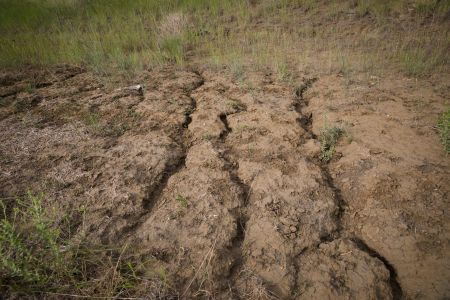
Rills in the landscape (USDA, 2025)[18]
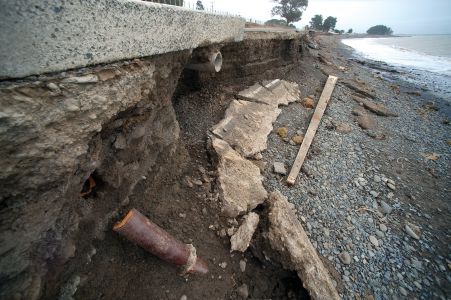
Undermined roads or buildings (NIWA, 2011).[19]
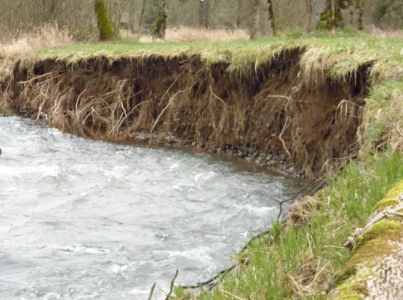
Exposed soil and roots (Clackamas Soil and Water Conservation District, 2017)[21]


Erosion potential[edit]

The potential for soil erosion is influenced by several factors, including (STEP, 2019)[17]:
- Rainfall characteristics: Droplet size, intensity, frequency, duration
- Climate: Soil temperatures, types of native vegetation, time of year
- Topography: Slope length and steepness
- Soil type: Soil texture, structure, permeability, organic matter content
- Ground cover: Type and quality/areal density of cover
| Soil Type | Ground Cover | Erosion Potential |
|---|---|---|
|
Well graded gravel |
Densely vegetated areas Sodded/established vegetated areas Soil sealant and rolled erosion controls Hydroseeded/hydromulch areas prior to growth Established temporary crop covered/vegetated lands Seeded lands prior to growth Sparsely vegetated lands Bare lands (exposed soil) |
Least |

Erosion and LID[edit]


LID can help to minimize conditions that lead to erosion by:
- Reducing runoff volume: Practices like infiltration trenches and permeable pavements allow water to soak into the ground, reducing runoff volume. LID practices also often promote evaporation and evapotranspiration.
- Reducing runoff speed: LID features like vegetated swales help slow the speed of water by increasing surface roughness. This reduces the velocity of runoff that would otherwise erode soil surfaces.
- Stabilizing soils: Vegetated components (e.g., filter strips) anchor the soil with plant roots, protecting surfaces from erosion.
- Applying Erosion and Sediment Control during construction: Slowing runoff, trapping sediment, and protecting exposed soils reduces the amount of sediment released during construction. It is especially important to apply erosion and sediment controls during LID construction, since sediment build-up in infiltration-based LID BMPs can result in malfunction or failure (MECP, 2021)[8].
- Controlling flow paths: Controlling the path of water helps to prevent the formation of concentrated flow paths that can intensify erosion, such as rills or gullies.
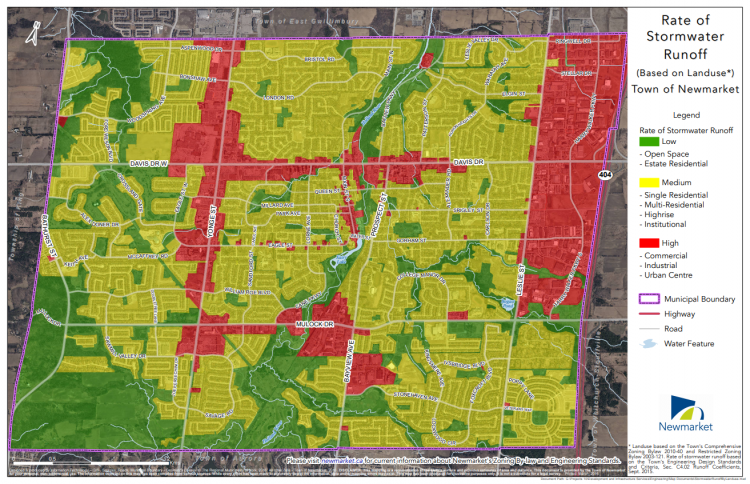
The map below highlights areas in Newmarket, Ontario with low, medium, and high stormwater runoff rates based on land use. The red areas, which have the highest runoff rates, are locations where erosion is also likely to be more severe. These zones should be prioritized for future LID projects to reduce runoff volume and limit erosion.

References[edit]
- ↑ Gregg, P. 2009. Soil erosion and conservation – Types of erosion, Te Ara – the Encyclopedia of New Zealand, https://teara.govt.nz/en/photograph/19792/streambank-erosion
- ↑ Hitson, H. 2022. 'A long time coming': EPA settles pollution case against Alabama solar farm after four years. https://www.montgomeryadvertiser.com/story/news/2022/11/29/lafayette-solar-farm-clean-water-act-violations/69672327007/
- ↑ Glenn, W. 2024. How Much Does It Cost To Dredge A Pond? https://lakemanagementinc.net/how-much-does-it-cost-to-dredge-a-pond/
- ↑ 4.0 4.1 TRCA. 2020. Ravine and Bluff Brochure. https://trcaca.s3.ca-central-1.amazonaws.com/app/uploads/2020/04/27105442/Ravine-and-Bluff-Brochure.pdf
- ↑ Agriculture and Agri-Food Canada. 2025. Soil erosion. https://agriculture.canada.ca/en/environment/resource-management/indicators/soil-erosion.
- ↑ Toronto and Region Conservation Authority. 2025. Erosion Risk Management. https://trca.ca/conservation/erosion-risk-management/
- ↑ TRCA. 2025a. TRCA Annual Regulation Mapping Update. https://trca.ca/regulation-mapping-update/
- ↑ 8.0 8.1 8.2 8.3 Ministry of the Environment, Conservation and Parks. 2022. Low Impact Development Stormwater Management Guidance Manual. Chapter 7. https://prod-environmental-registry.s3.amazonaws.com/2022-01/Draft%20LID%20Stormwater%20Management%20Guidance%20Manual%202022.pdf
- ↑ Bledsoe, B. (2002). Stream erosion potential and stormwater management strategies. Journal of Water Resources Planning and Management, 128 (6), 451-455.
- ↑ Kemp, P., Sear, D., Collins, A., Naden, P., Jones, I. 2011. The impacts of fine sediment on riverine fish. https://doi.org/10.1002/hyp.7940.
- ↑ Baker, J. David, M. Lemke, D. 2006. Understanding nutrient fate and transport, including the importance of hydrology in determining losses, and potential implications on management systems to reduce those losses. https://www.epa.gov/sites/default/files/2015-07/documents/2006_8_24_msbasin_symposia_ia_session1.pdf
- ↑ McDonough, K., Moore, T., & Hutchinson, S. (2017). Understanding the relationship between stormwater control measures and ecosystem services in an urban watershed. J. Water Resources and Planning Management, 143 (5)
- ↑ Tian, M., Gao, J., Zhang, L., Zhang, H., Feng, C., Jia, X. 2021. Effects of dust emissions from wind erosion of soil on ambient air quality. https://doi.org/10.1016/j.apr.2021.101108.
- ↑ CISEC Canada. 2011. Certified Inspector of Sediment and Erosion Control Training Manual. https://sustainabletechnologies.ca/app/uploads/2019/11/Manual-2019-Fed_Oct2019.pdf
- ↑ Ferreira, C., Kalantari, Z., Seifollahi-Aghmiuni, S., Ghajarnia, N., Rahmati, O., Solomun, K.M. 2021. Chapter 21 - Rainfall-runoff-erosion processes in urban areas. Pages 481-498. https://doi.org/10.1016/B978-0-12-822699-5.00018-5
- ↑ Government of Alberta. 2011. Erosion Control Manual. https://open.alberta.ca/dataset/aaae5384-c0e0-4421-9fd8-6ab835c6f3af/resource/f3734079-ebae-4872-bf6c-96831ffce9b2/download/trans-erosion-and-sediment-control-manual-section-4.pdf
- ↑ 17.0 17.1 17.2 STEP. 2019. The Erosion and Sediment Control Guide for Urban Construction. https://sustainabletechnologies.ca/app/uploads/2020/01/ESC-Guide-for-Urban-Construction_FINAL.pdf
- ↑ USDA Natural Resources Conservation Service South Dakota. 2025. Soil Erosion. https://www.sdresourceconcerns.org/resource-concern-soil-erosion/
- ↑ NIWA. 2011. Water & Atmosphere 3. https://niwa.co.nz/water-atmosphere/water-atmosphere-3-november-2011/upping-ante
- ↑ Valor Environmental. 2023. The Beginner’s Guide to Erosion and Sediment Control. https://www.valorenv.com/the-beginners-guide-to-erosion-and-sediment-control/
- ↑ Clackamas Soil and Water Conservation District. 2017. Winter Storms Bring Streambank Erosion. https://conservationdistrict.org/2017/winter-storms-bring-stream-bank-erosion.html#foobox-1/0/Bank_erosion_Milk_Creek_site-28Feb2012-reduced.jpg?ssl=1
- ↑ Grow Me In stead. 2020. A Guide for Southern Ontario: Beautiful Non-Invasive Plants for your Garden. https://www.ontarioinvasiveplants.ca/wp-content/uploads/2020/04/Southern-Grow-Me-Instead-1.pdf
- ↑ Town of Newmarket. 2024. Low Impact Development and Green Infrastructure. https://www.newmarket.ca/LivingHere/Pages/Environment%20and%20Sustainability/Low%20Impact%20Development%20and%20Stormwater%20Management/Green-Infrastructure.aspx.
