Difference between revisions of "Check dams"
Jump to navigation
Jump to search
Jenny Hill (talk | contribs) m |
Jenny Hill (talk | contribs) m |
||
| Line 12: | Line 12: | ||
===Gallery=== | ===Gallery=== | ||
| − | {{Check dams: Gallery}} | + | {{:Check dams: Gallery}} |
Revision as of 18:29, 23 October 2017
Check dams are small dams or weirs constructed across a drainage ditch, swale, or channel to lower the speed of concentrated flows for a certain design range of storm events and to promote infiltration.
Check dams:
- may be constructed of any resilient and waterproof material, including: rock gabions, earth berms, coarse aggregate or rip-rap, concrete, metal or pre-treated timber. Rocks used in check dams should have median diameter 25-75 mm.
- for enhanced swales may be up to 0.6 m in height; the maximum design depth of ponded water should be ≤ 0.6 m.
- designed for higher flow velocities should have spillways incorporated into their profile, to direct water to the centre of the swale.
- are usually installed between 10-20 m along the swale. The spacing of dams should not exceed the horizontal distance from the toe of the upstream dam to the same elevation on the downstream dam.
- should have energy dissipation and erosion control measures installed in the 1 - 2 m downstream. Examples include large aggregate or turf reinforcement
Sizing and spacing of check dams[edit]
Gallery[edit]
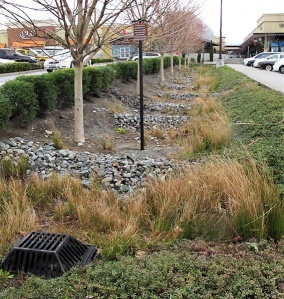
Enhanced swale with rocky check dams and a metal overflow grate in Northgate Mall parking lot, Seattle. Photo credit: MLSmith
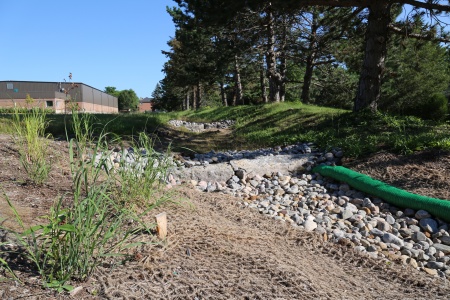
Bioswale with rock check dams to slow down the water, encouraging infiltration. Note the biodegradable erosion control blanket still in place. LSRCA headquarters, 2017
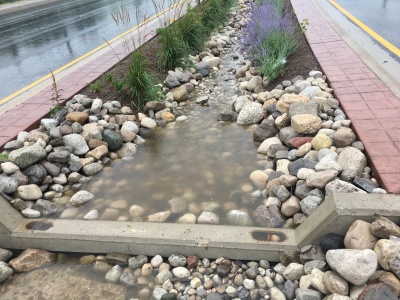
A check dam in action, effectively pooling water.
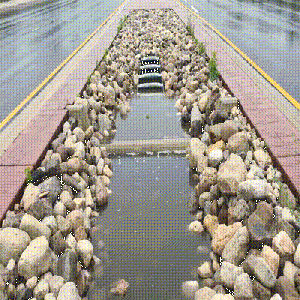
A swale during a rain event, with concrete check dams and armourstone to slow down moving water to promote infiltration in the feature.


Also see Jen's Pinterest board of check dams