CLI-ECA

Overview[edit]

The Municipal Consolidated Linear Infrastructure Environmental Compliance Approval (CLI-ECA) is a streamlined approval process for municipalities managing wastewater, stormwater, and Low Impact Development (LID) infrastructure. The CLI-ECA replaces the need for municipalities to apply for multiple, project-specific Environmental Compliance Approvals (ECAs) every time they want to make changes or additions to their water, wastewater, or stormwater collection systems. CLI-ECAs authorize municipalities to make changes to the system when requirements in the CLI-ECA are met (MECP, 2024)[2]. MECP requires all municipalities in Ontario to enroll into the CLI-ECA program by application. Each municipality will receive:
- One CLI-ECA for their municipal sewage collection system
- One CLI-ECA for their municipal stormwater management system (MECP, 2025)[3]
Step-by-step compliance process[edit]

Step 1: Determine if your project falls under CLI-ECA[edit]
If you are a developer or prescribed person, contact the municipality where your project is located to determine if they have received a CLI-ECA and obtain a copy. You must then identify whether the proposed wastewater or stormwater project qualifies as a pre-authorized alteration under the CLI-ECA. Common eligible projects include:
Stormwater:
- Storm sewer upgrades or extensions
- Alterations to stormwater management facilities (e.g., wet ponds, dry ponds, wetlands)
- Implementation or modification of LID practices (e.g., bioretention, infiltration trenches, permeable pavements)
Wastewater:
- Sewage works used for the collection, storage, pumping, and transmission of sanitary sewage, excluding treatment
- Municipal-owned eligible sewage works for collection of sanitary sewage
- Combined sewers and combined sewage storage structures that collect and convey both wastewater from residential, commercial, institutional and industrial buildings and stormwater runoff through a single-pipe system
- Pumping stations
- Sewage works used for the management of residue or odour
If you determine that your project falls under the CLI-ECA, refer to the municipality for guidance on how to submit an application. Works that do not qualify as a pre-authorized alteration under the CLI-ECA must instead go through a standalone, project-specific Environmental Compliance Approval (ECA) process
Step 2: Review design criteria and standards[edit]
Ensure project design and objectives follow:
- MECP's MECP’s Design Criteria for Sanitary Sewers, Storm Sewers and Forcemains for Alterations Authorized under an Environmental Compliance Approval (2023)[4]
- MOE's Design Guidelines For Sewage Works (2016)[5]
- MECP'sLow Impact Development Stormwater Management Guidance Manual Draft (2022)[6].
- MOE'sOntario Stormwater Management Planning and Design Guidance Manual (2003)[7]
- STEP's Low Impact Development Stormwater Management Planning and Design Guide Wiki
Step 3: Complete required documentation[edit]
Use the appropriate compliance forms based on project type:
Prepare a Design Report including:
Step 4: Obtain engineering and owner verification[edit]
A Licensed Engineering Practitioner must verify that:
- The design aligns with CLI-ECA criteria.
- The system is designed for proper stormwater management without negative impacts.
The Municipal Owner must sign off on compliance forms confirming:
- The alteration does not result in adverse effects.
- It aligns with jurisdictional stormwater management objectives.
Step 5: Submit a director notification (if required)[edit]
Some alterations require notification to the MECP Director within specific timeframes:
- 30 days after placing new works into service.
- 90 days if previously undocumented infrastructure is discovered.
The notification must include:
- Project description
- Verification documents
- Compliance assessment
Step 6: Conduct post-construction inspection and verification[edit]
- Inspect LID and stormwater systems to ensure they function as designed. Refer to Low Impact Development Stormwater Management Practice Inspection and Maintenance Guide and Inspection and Maintenance Guide for Stormwater Management Ponds and Constructed Wetlands
- Complete "Post-Construction Verification" on relevant forms.
- Document key performance indicators such as infiltration rates, flow control effectiveness, and pollutant removal efficiency.
Step 7: Maintain ongoing compliance and record-keeping[edit]
Establish a Stormwater System Maintenance Plan that includes:
- Routine inspections (e.g., sediment removal, vegetation management)
- Adaptive management strategies for system improvements
Retain compliance records for a minimum of 10 years.
CLI-ECA application[edit]
Municipalities in Ontario are required to submit a CLI-ECA application to the Ministry of the Environment, Conservation and Parks (MECP). If you are planning to establish a new municipal sewage collection system or municipal stormwater management system in a municipality that does not have a CLI ECA, arrange a pre-submission meeting with MECP [2]. Below is MECP's Guide to Applying for the First Consolidated Linear Infrastructure Environmental Compliance Approval (2021)[8] and an example Environmental Compliance Approval for the City of Peterborough's stormwater system (2023)[9]. You can download (downward facing arrow on the top righthand side) and print (Printer emoticon on top right hand side) each PDF.
Annual reports[edit]
Municipalities in Ontario are required to submit annual performance reports as per the conditions in the CLI-ECA, which must be made available to the public at no charge. Specific requirements for the report will be listed in the CLI-ECA, but typically include (MECP, 2024)[2]:
- the timeframe that the report must cover and due date
- monitoring data and environmental trends
- operating problems encountered and corrective action
- maintenance and repair activities undertaken
- complaints received about the system and steps taken to address them
- spills and abnormal discharge events
- changes made to the system and any actions to improve or correct performance of the system
Below are examples of these reports, including Mississauga's Stormwater System Performance Report (2024)[10], Newmarket's Wastewater System Performance Report (2024)[11], and Wellington's Stormwater System Performance Report (2024)[12]. You can download (downward facing arrow on the top righthand side) and print (Printer emoticon on top right hand side) each PDF.
Operations and maintenance manuals[edit]
Conditions in the CLI ECA require the municipality to prepare and implement an operations and maintenance manual for the system. Requirements for what must be included in an O&M manual are listed in the CLI-ECA, but will typically include (MECP, 2024) [2]:
- operating and maintenance procedures for routine operation of the system
- inspection programs, including frequency of inspection and the methods or tests used to detect when maintenance is necessary
- maintenance and repair programs
- operational and maintenance requirements to protect sources of drinking water, such as those included in the ministry’s Standard Operating Policies for Sewage Works Document. This procedure can be *downloaded through Environmental Registry #012-2968 and any applicable local source protection plan policies
- procedures for the inspection and calibration of monitoring equipment
- emergency response, spill reporting, contingency plans and procedures for dealing with equipment breakdowns, potential spills and any other abnormal situations
- procedures for receiving, responding and recording public complaints
- as-built drawings or record drawings
Click on the image to read a presentation on O&M Manual Development under the CLI-ECA by the Town of Newmarket (2025)[13].
Monitoring[edit]
CLI-ECA requires municipalities to implement a stormwater receiver monitoring program
- Draft manual to be released in ~January, 2026*
- Finalized in ~June, 2026*
- Comes into enforcement ~June, 2028*
Existing real time monitoring or other instream monitoring programs CAs employ will provide data that municipalities need.
*Approximate dates to be confirmed
This section will be updated as information becomes available.
Updates[edit]
2020
- CLI-ECA introduced (Environmental Registry of Ontario, 2020)[14]
2023
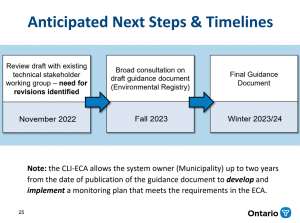
- Monitoring guidance draft under review with existing technical stakeholder working group – need for revisions identified
Click on the button below to read the 2023 Source to Stream Conference Presentation by MECP and LSRCA[1]
2025
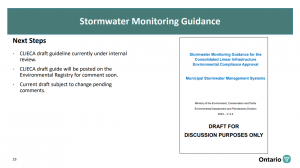
- Monitoring Guidance for CLI-ECA is under internal review. Note: municipalities are allowed up to two years from the date of publication of the guidance document to develop and implement a monitoring plan that meets the ECA requirements
Click on the button below to read the 2025 Source to Stream Conference Presentation by MECP[3]
References[edit]
- ↑ 1.0 1.1 MECP and LSRCA. 2023. Panel Presentation: Monitoring and the Consolidated Linear Infrastructure Environmental Compliance Approval (CLI-ECA) Framework: Understanding and Applying Ontario’s New Requirements for Municipal Stormwater Infrastructure. Source to Stream Conference. https://sourcetostream.com/2023-panel/
- ↑ 2.0 2.1 2.2 2.3 2.4 MECP. 2024. https://www.ontario.ca/page/municipal-consolidated-linear-infrastructure-environmental-compliance-approvals
- ↑ 3.0 3.1 MECP. 2025. Bringing the CLI-ECA Framework into Action: Guiding Principles to Inform Stormwater Management Practices. Source to Stream Conference Presentation. https://sourcetostream.com/app/uploads/2025/04/Day-2-Hall-A-Presentation-2-DSmith-AAhmed.pdf
- ↑ MECP. 2023. Design Criteria for Sanitary Sewers, Storm Sewers and Forcemains for Alterations Authorized under an Environmental Compliance Approval. https://www.kitchener.ca/en/resourcesGeneral/Documents/INS_SSU_Design_Criteria.pdf
- ↑ MOE. 2016. Design Guidelines For Sewage Works https://www.ontario.ca/document/design-guidelines-sewage-works-0#.
- ↑ MECP. 2022. Low Impact Development Stormwater Management Guidance Manual Draft. https://ero.ontario.ca/public/2022-01/Draft%20LID%20Stormwater%20Management%20Guidance%20Manual%202022.pdf
- ↑ MOE. 2003.Ontario Stormwater Management Planning and Design Guidance Manual. https://dr6j45jk9xcmk.cloudfront.net/documents/1757/195-stormwater-planning-and-design-en.pdf
- ↑ MECP. 2021. Guide to Applying for the First Consolidated Linear Infrastructure Environmental Compliance Approval. https://wcwc.ca/wp-content/uploads/2024/05/CLI-ECA-Application-Guide.pdf
- ↑ Environmental Compliance Approval For a Municipal Stormwater Management System. https://www.peterborough.ca/media/ucbdw0wf/eca-number-145-s701-storm-issue-2.pdf
- ↑ City of Mississauga. 2024. 2024 Annual Performance Report – Mississauga Stormwater Management System. https://www.mississauga.ca/wp-content/uploads/2025/05/12153249/2024-Annual-Performance-Report-Mississauga-stormwater-system.pdf
- ↑ Town of Newmarket. 2024. Annual Wastewater Collection System Performance Report. https://care.newmarket.ca/LivingHere/Documents/Wastewater%20Reports/TON%202024%20Annual%20Wastewater%20Collection%20System%20Performance%20Report.pdf
- ↑ Wellington County. 2024. Wellington County Stormwater Management System Annual Performance Report. https://www.wellington.ca/media/file/2024-annual-performance-reportpdf
- ↑ Schritt, C. & MacDonald, M. 2025. Stormwater Under Pressure: Navigating O&M Manual Development under the CLI-ECA. Source to Stream Conference Presentation. https://sourcetostream.com/2025-track-1-day-2-schritt-macdonald/
- ↑ Environmental Registry of Ontario. 2020. Proposed changes to environmental approvals for municipal sewage collection works. https://ero.ontario.ca/notice/019-1080#:~:text=We%20anticipate%20receiving%20the%20first,ready%20to%20transition%20to%20CLI%20.