Protecting LID features during construction: Gallery
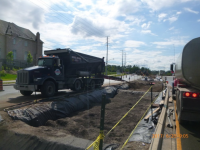
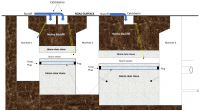
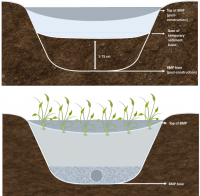
Phase construction so that LID measures are constructed last. Underground LID features can be built early in the construction process, provided they are protected by a barrier such as a plug. Graphic shows an exfiltration system with a temporary plug keeping construction runoff out of the exfiltration area.
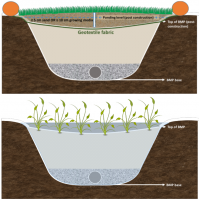
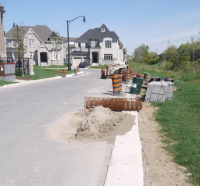
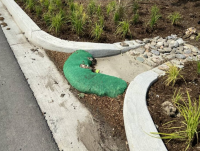
Keep LID installations offline via flow diversion until construction is complete, the drainage area is stabilized, and vehicle mud tracking is stopped. Image shows a bioretention feature during construction (left) and post-construction (right). The LID feature is protected using geotextile fabric, a sacrificial layer of stabilized sand/growing media with vegetation, and a filter sock. Once surrounding construction is complete, the layer of growing media is removed and the BMP starts receiving flow.
Low Impact Development. A stormwater management strategy that seeks to mitigate the impacts of increased urban runoff and stormwater pollution by managing it as close to its source as possible. It comprises a set of site design approaches and small scale stormwater management practices that promote the use of natural systems for infiltration and evapotranspiration, and rainwater harvesting.
Gravel, or crushed stone of various size gradations (i.e., diameter), used in construction; void forming material used as bedding and runoff storage reservoirs and underdrains in stormwater infiltration practices.
The downward movement of water through the soil, the downward flow of runoff from the bottom of an infiltration BMP into the soil.
Loss of water from a drainage system as a result of percolation or absorption into the surrounding medium (e.g., the infiltration of water into the native soil through a perforated pipe wall as it is conveyed).
The portion of water precipitated onto a catchment area, which then flows as surface discharge from the catchment area past a specified point.
Water from rain, snow melt, or irrigation that flows over the land surface.
Refers to a system that when full, stormwater will bypass the practice. Offline systems use flow splitters or bypass channels that only allow the water quality volume to enter the facility. This may be achieved with a pipe, weir, or curb opening sized for the target flow, but in conjunction, create a bypass channel so that higher flows do not pass over the surface of the filter bed.
The total surface area upstream of a point on a stream that drains toward that point. Not to be confused with watershed. The drainage area may include one or more watersheds.
Filter fabric that is installed to separate dissimilar soils and provide runoff filtration and contaminant removal benefits while maintaining a suitable rate of flow; may be used to prevent fine-textured soil from entering a coarse granular bed, or to prevent coarse granular from being compressed into underlying finer-textured soils.
Mineral particles which are smaller than 2 mm, and which are free of appreciable quantities of clay and silt. Coarse sand usually designates sand grains with particle size between 0.2 and 0.02 mm.
Best management practice. State of the art methods or techniques used to manage the quantity and improve the quality of wet weather flow. BMPs include: source, conveyance and end-of-pipe controls.
The temporary storage of stormwater to control discharge rates, and allow for sedimentation.
Ground depression acting as a flow control and water treatment structure, that is normally dry.
Soil, sand and minerals washed from land into water, usually after rain. They pile up in reservoirs, rivers and harbors, destroying fish-nesting areas and holes of water animals and cloud the water so that needed sunlight might not reach aquatic plans. Careless farming, mining and building activities will expose sediment materials, allowing them to be washed off the land after rainfalls.