Difference between revisions of "Protecting LID features during construction: Gallery"
ChristineLN (talk | contribs) |
ChristineLN (talk | contribs) |
||
| Line 1: | Line 1: | ||
| − | <gallery mode=" | + | <gallery mode="traditional" widths=200px heights=200px> |
|Keep LID perimeter controls in working order throughout construction. | |Keep LID perimeter controls in working order throughout construction. | ||
Screenshot 2025-11-12 114624.png|Protect LID inlets. | Screenshot 2025-11-12 114624.png|Protect LID inlets. | ||
Revision as of 19:09, 12 November 2025
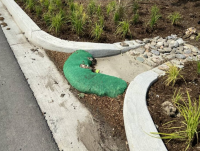
Protect LID inlets.
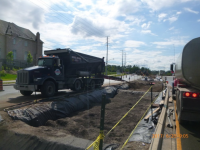
Avoid heavy equipment on infiltration areas (i.e., driving vehicles through filter beds, or over granular water storage and bedding layers). Identify and mark LID areas to increase awareness.
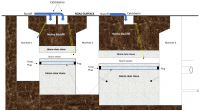
Phase construction so that LID measures are constructed last. Underground LID features can be built early in the construction process, provided they are protected by a barrier such as a plug. Graphic shows an exfiltration system with a temporary plug keeping construction runoff out of the exfiltration area.
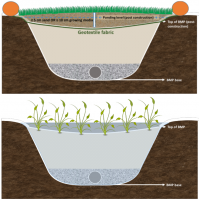
Keep LID installations offline via flow diversion until construction is complete, the drainage area is stabilized, and vehicle mud tracking is stopped. Image shows a bioretention feature during construction (left) and post-construction (right). The LID feature is protected using geotextile fabric, a sacrificial layer of stabilized sand/growing media with vegetation, and a filter sock. Once surrounding construction is complete, the layer of growing media is removed and the BMP starts receiving flow.
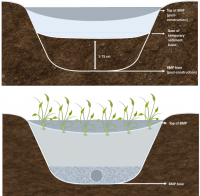
Avoid using LID areas as temporary detention basins, but in cases where flow cannot be routed around LID areas, protection should be used to prevent accumulated sediment from migrating into the subgrade. Graphic shows a bioretention feature during construction (left) and post-construction (right). At least 75 cm of native soil is retained between the base of the detention basin and the base of the LID feature, so that sediment accumulation in the detention basin can be removed. Once it is excavated and filled, ESC measures should be put in place to protect it until all drainage area construction and stabilization are complete.
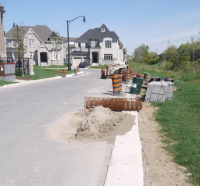
Be mindful of stockpile locations relative to LID areas.
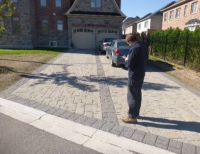
Inspect LID areas during ESC site inspections.


